New Driving Simulator Arrives at the Faculty of Transport and Traffic Sciences
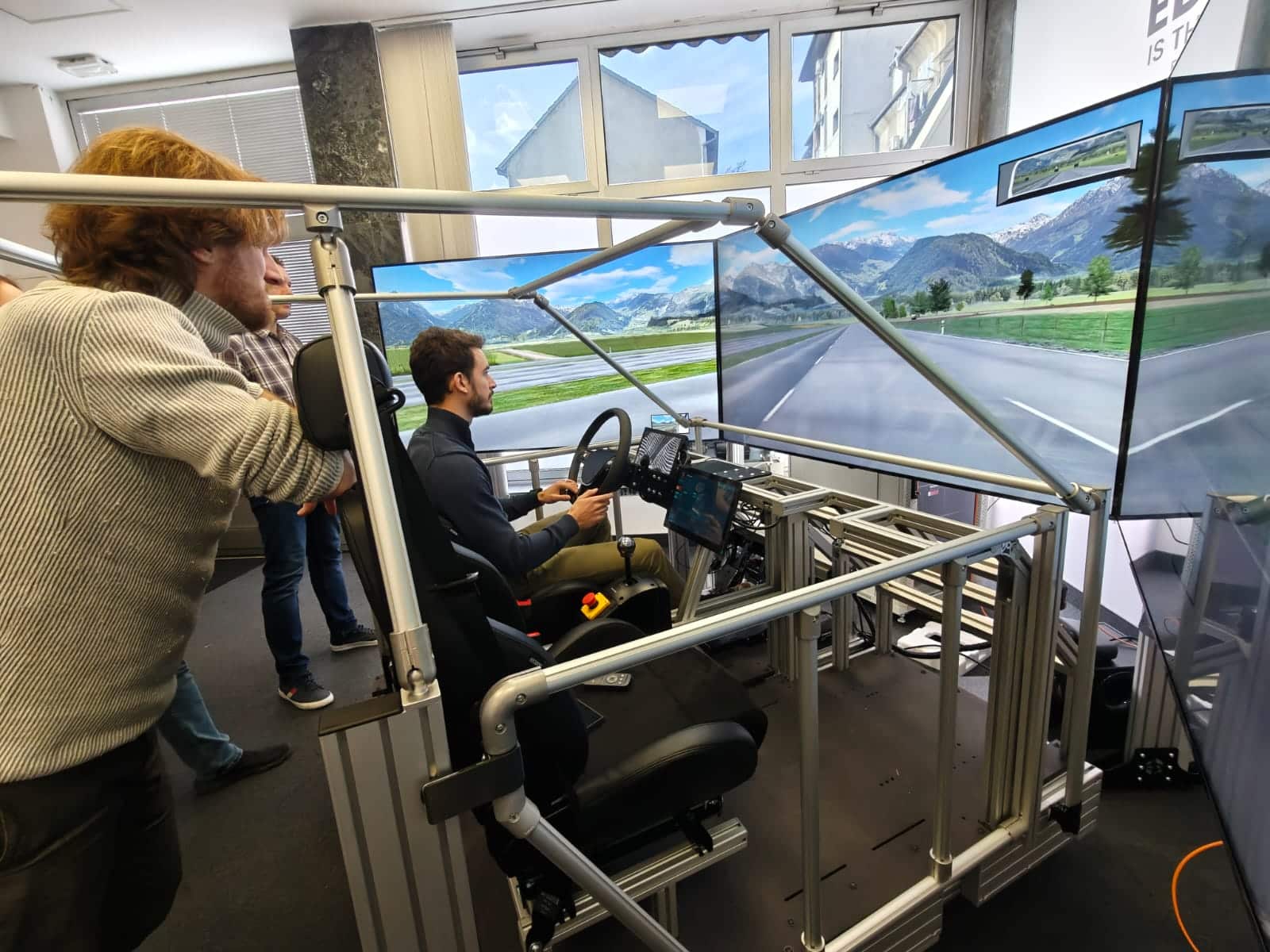
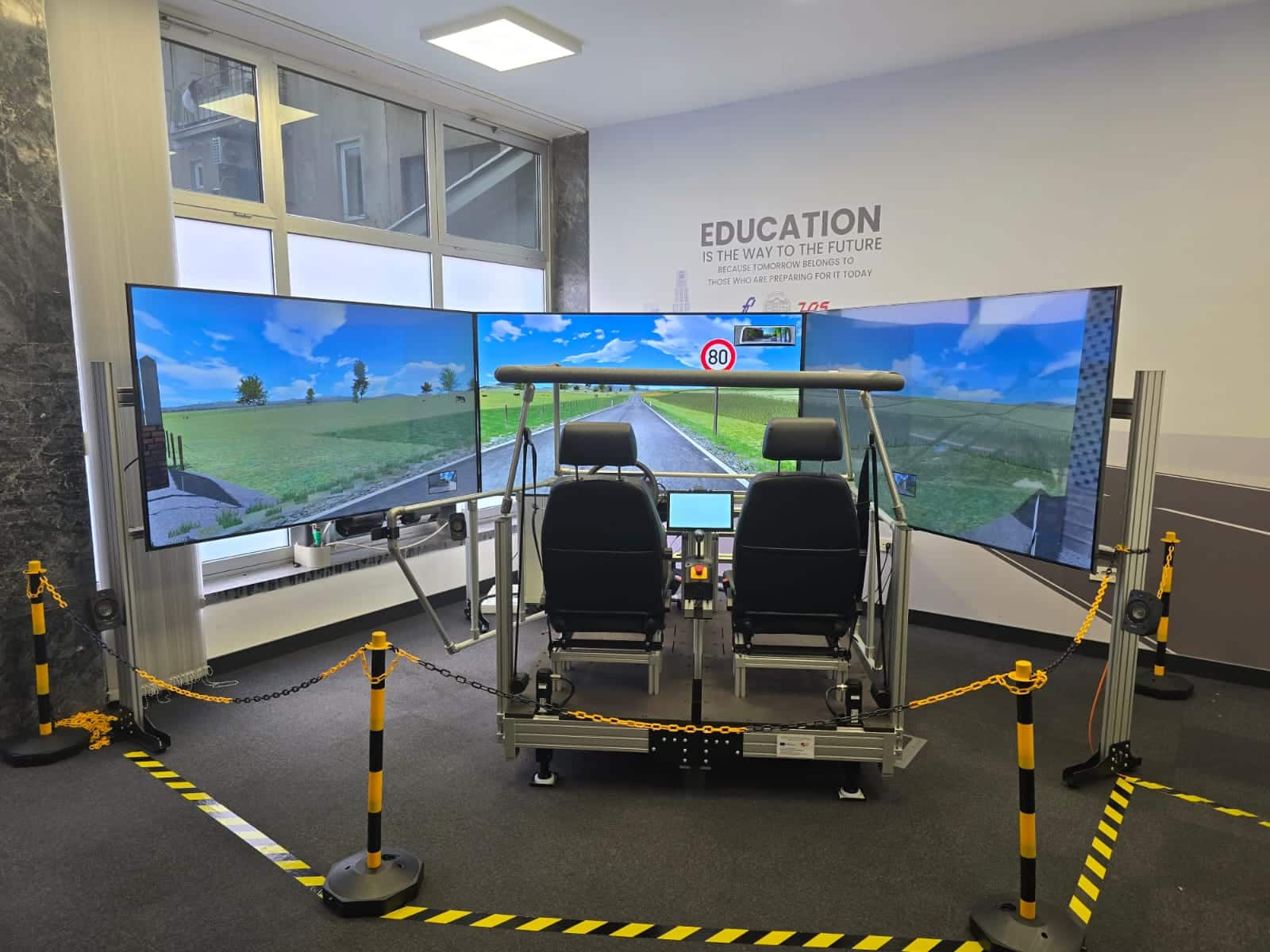
The Faculty of Transport and Traffic Sciences, University of Zagreb, is currently developing the Road Simulation Laboratory, a research facility designed for the analysis of road traffic scenarios in controlled conditions. The laboratory will support scientific research, testing, and evaluation of traffic management solutions and road safety measures.
We are pleased to announce that a new driving simulator has been delivered, representing an important milestone in the establishment of the Road Simulation Laboratory. The simulator was financed through the TWIN-SAFE project, as well as through funds from the Croatian National Road Safety Plan, which were specifically allocated for the development of the Centre of Excellence for Road Traffic Safety (CERTS).
The introduction of this advanced research equipment will further strengthen the Faculty’s research infrastructure and contribute to the development of innovative approaches to road safety.
Internships on Project Management and Research Practices
As part of the project’s capacity-building and knowledge-exchange activities, project team members participated in two internships focused on project management, research support, and innovation management, held in Hasselt, Belgium, and Lund, Sweden.
The internship in Hasselt focused on research and project management within the academic and innovation ecosystem, covering industrial research funding mechanisms, project management and support structures, business development, research consultancy, and proposal writing. Additional sessions addressed innovation and spin-off policies, as well as GDPR, ethics, and research data management.
The internship in Lund addressed ethical, organisational, and communication aspects of research projects, with a focus on simulations and experiments involving human participants. Key topics included ethics and privacy management, science communication, and experience sharing from ERC-funded projects, alongside group-based project work and study visits to Lund University laboratories and research offices. Overall, these internships significantly strengthened the project team’s capacities in project management, research support, ethics, and international research collaboration.
Progress of The Research Part of Project
Significant progress has been achieved in the research component of the project. By October 2024, the Faculty of Transport and Traffic Sciences (FTTS) successfully recruited a total of 72 participants for the purposes of collecting naturalistic driving data, including 53 car drivers and 19 motorcyclists, thereby exceeding the originally defined KPI target of 40 participants.
Using the TOECAN mobile application, naturalistic driving data were continuously collected until June 2025. The dataset includes a total of 8,338 hours of driving for car drivers and 2,106 hours for motorcyclists, covering cumulative distances of 417,399 km and 107,659 km, respectively.
The data analysis phase has commenced, and the first scientific results have already been achieved, with one research paper accepted for presentation at the TRANSCODE 2025 Conference. In parallel, the project team is collaborating with Croatian Roads Ltd. and utilizing GIS-based datasets to prepare iRAP-based road safety assessments. The collected data will undergo detailed statistical analysis to identify correlations between driver behaviour and infrastructure features, leading to the identification of risky road segments.
To promote transparency and further scientific collaboration, the collected dataset has been published in open access and is publicly available via the Zenodo repository.
Grant Writing Training Programme to Strengthen Research and Project Management Capacities
Within the work package “Developing an international research environment with strong project management capabilities”, a grant writing training programme was organised for researchers of the Faculty of Transport and Traffic Sciences (FTTS) in collaboration with Lund University (LU) and Hasselt University (HU).
The training programme was delivered through a combination of on-site and online workshops and organised in collaboration with Lund University (LU) and Hasselt University (HU). Its primary objective was to strengthen researchers’ competencies in proposal preparation, grant writing, and funding strategies, building on the extensive experience of LU and HU in national and international research projects. As part of the programme, researchers were introduced to key aspects of proposal preparation and grant writing, including funding opportunities within Horizon Europe, challenges of multidisciplinary research, project structuring and risk management, articulation of project impact, and coordination of large-scale research projects.
Workshops Supporting the Development of the Civic Mission of the Faculty of Transport and Traffic Sciences
Within the framework of the TWIN-SAFE project, a series of collaborative workshops was organised between the Faculty of Transport and Traffic Sciences (FTTS), University of Zagreb, and Hasselt University (HU) with the aim of supporting the development of FTTS’s Civic University Mission.
The workshops focused on exploring how FTTS contributes to society and how its activities can be further aligned with the principles of a civic university, strengthening the Faculty’s role in addressing societal, economic, and regional challenges. The first workshop was held in person in Hasselt, Belgium, while the second and third workshops were conducted online.
During the workshops, participants mapped FTTS’s current activities and impacts across three key areas: estates and placemaking, economic impact, and social impact. Discussions addressed topics such as community engagement, collaboration with industry and public institutions, inclusive and sustainable mobility, research and innovation activities, and the Faculty’s role in improving employability and regional development. The later workshops built on the initial findings and focused on defining the scope, strategic direction, and long-term objectives of FTTS’s civic mission.
Road Safety Summer School 2025 Successfully Concluded
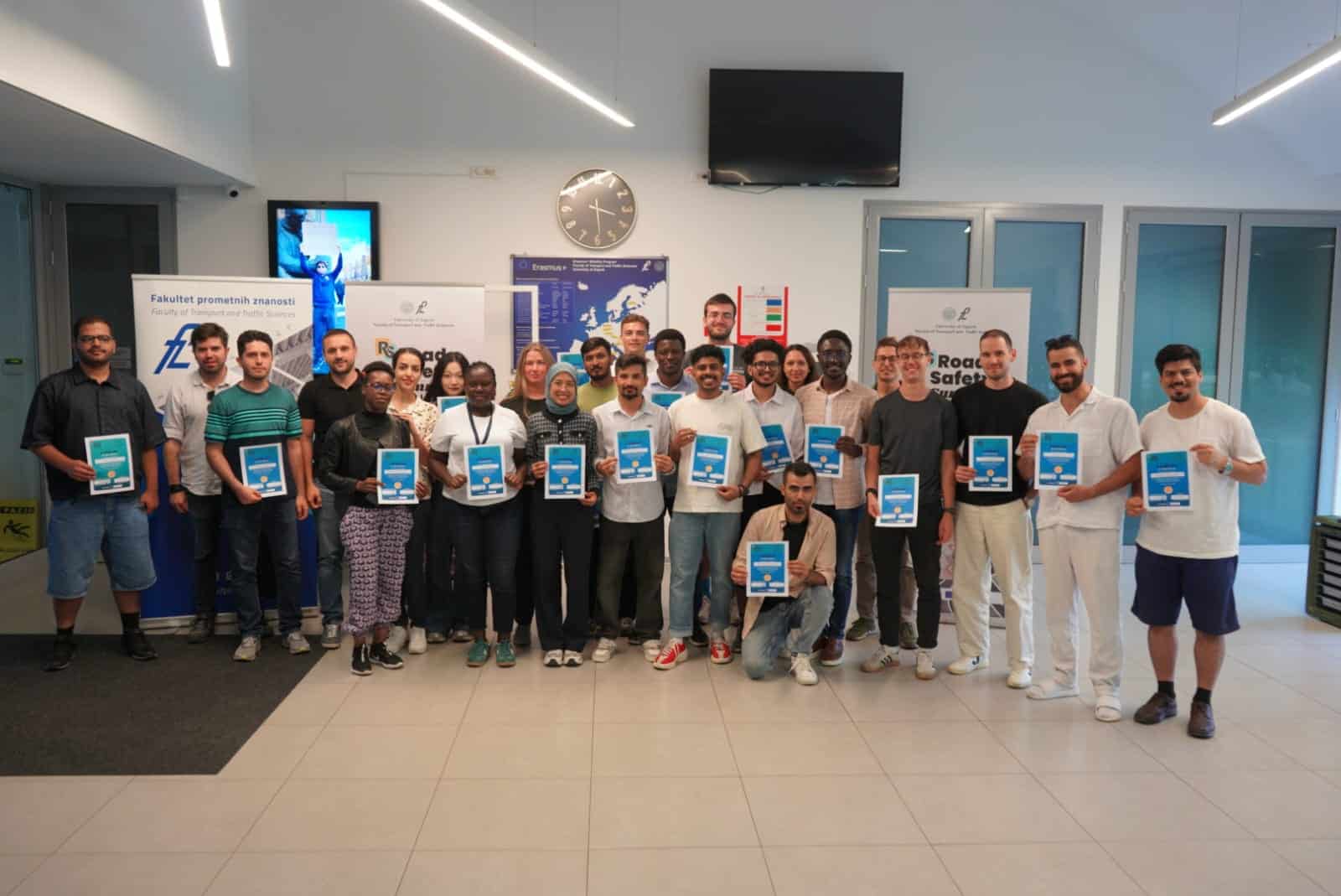
From August 25 to September 2, 2025, the Faculty of Transport and Traffic Sciences, University of Zagreb successfully organized the fifth consecutive edition of the Road Safety Summer School, held at the Scientific and Educational Campus Borongaj in Zagreb. Over the past years, this prestigious program has grown into a recognized international platform for education, networking and the exchange of experiences in the field of road safety.
This year, the Summer School gathered 26 participants from 13 countries across Europe, Asia and Africa, including Cameroon, Jordan, India, China, Belgium, Iran, Germany, Turkey and other. Participants had the opportunity to learn from more than 20 leading experts through lectures, workshops, group projects and fieldwork.
The program was co-financed through the Horizon Europe project “TWIN-SAFE: Advancing Road Safety Through Twinning”, coordinated by the Faculty of Transport and Traffic Sciences. Its main objective was to provide advanced professional training in road safety and to promote a holistic approach to tackling one of today’s most pressing transport challenges.
The lectures and activities were structured around the key factors of road safety: the human factor, vehicles and road infrastructure with its environment.
Day 1: Official opening and “Road Safety Across Borders” – an interactive exchange of national experiences.
Day 2: Human factors in traffic safety – from psychological processes and driver perception to risk communication and media campaigns.
Day 3–5: Road and environment – safe road design, roundabouts, road markings and signs, traffic light systems, roadside safety measures, motorcycle safety and level crossings safety.
Day 6: Crash analysis – Event Data Recorders, technical inspections, black spot identification and a live crash test on test field demonstration.
Day 7: Road safety management – safety audits, inspections, crash modification factors and international road safety assessment practices.
Day 8: Field work – participants carried out a road safety inspection on-site, analyzed findings and proposed solutions.
In addition to experts from the Faculty of Transport and Traffic Sciences, the Summer School featured world-renowned lecturers such as Harald Mosböck (SWARCO, Austria), Valeria Di Giacomo (Lindsay Corporation, Italy), Prof. Ali Pirdavani and Prof. Kris Brijs (Hasselt University, Belgium), Prof. Carmelo D’Agostino (Lund University, Sweden), as well as Prof. Attila Borsos and Prof. Dániel Miletics (University of Győr, Hungary).
We sincerely thank all lecturers, participants, partners, and sponsors – including Coca-Cola HBC, Atlantic Grupa, Zagrebačka pivovara, Ekipa Kombucha, SWARCO, Lindsay Corporation, MICRO-LINK and Trend-Tech Synergie – whose contributions were key to the success of the 2025 Summer School.
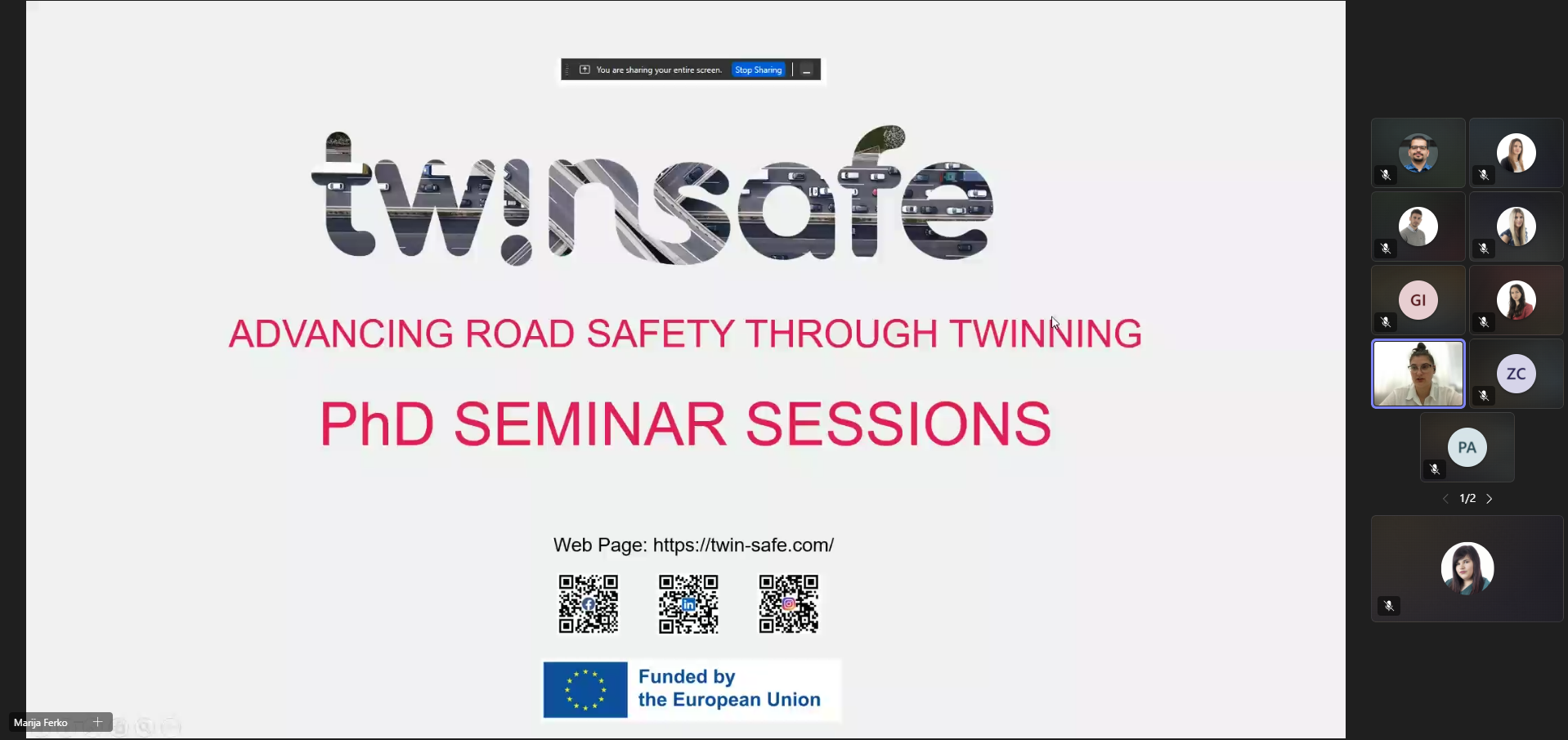
Today we hosted the final event in our TWIN-SAFE PhD seminar series!
Marija Ferko delivered a compelling presentation titled:
“Unveiling the Key Factors Behind Injury Severity in Single-Vehicle Motorcycle Crashes”
As a Cotutelle PhD student at both the University of Zagreb and Hasselt University, Marija presented her research using police-reported crash data from Croatia (2017–2022). She explored the severity of single-vehicle motorcycle crashes through two modeling approaches: Multinomial Logistic Regression and Random Forest Modeling to investigate the key determinants of crash severity.
Huge thanks to everyone who joined us for this seminar and throughout the TWIN-SAFE series. Your engagement made this journey truly meaningful!